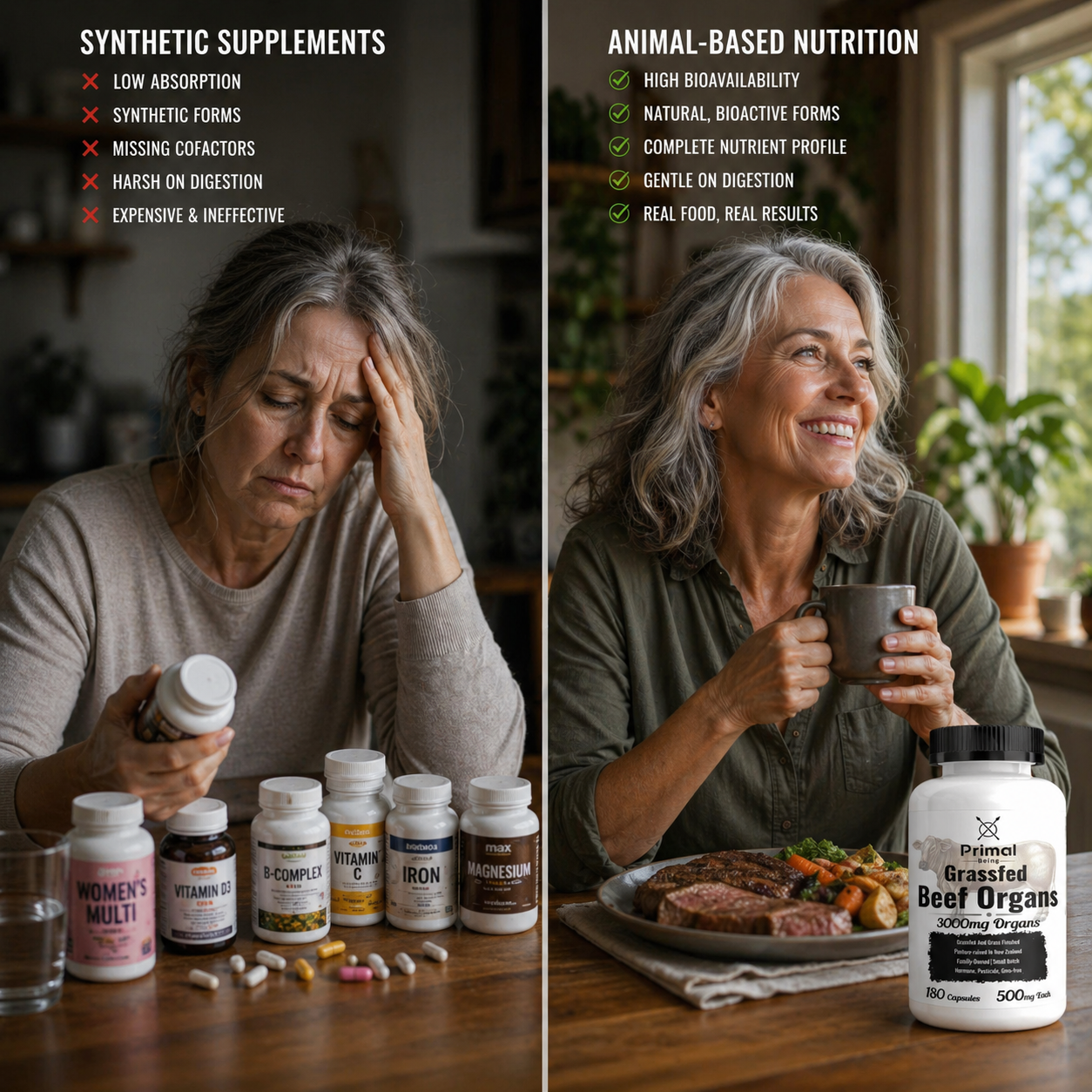

kaWalk into any supplement store and the women's section is hard to miss.
Pink labels. Flowery fonts. Promises about energy, glow, and balance. The marketing is targeted. The ingredients behind it are often the same synthetic compounds found in every other product on the shelf, just repackaged for a different buyer.
Most women's supplements are built around what sells, not what the body actually needs. Understanding the difference changes how you think about the whole category.
The Nutrients That Actually Matter
Women have specific nutritional needs that shift across different stages of life. The core gaps are consistent and well documented.
Iron is the most common deficiency in women worldwide. Menstruation creates a monthly demand for iron that most diets do not fully replace. Low iron shows up as fatigue that does not resolve with sleep, poor concentration, hair shedding, and a general feeling of running below capacity. The problem is not always intake. It is the form. Synthetic iron supplements are hard on the digestive system and absorbed inconsistently. Heme iron from animal sources is absorbed at a significantly higher rate and does not cause the nausea and constipation that iron pills are known for.
Folate supports cell division, red blood cell production, and fetal neural development. It is critical for women of reproductive age. The important distinction is between folate and folic acid. Folic acid is the synthetic version found in most supplements and fortified foods. The body has to convert it into the active form, methylfolate, before it can use it. A significant portion of the population, particularly those with MTHFR gene variants, cannot make that conversion efficiently. Real food folate arrives in its active form. No conversion required.
B12 supports nerve function, energy production, and the formation of healthy red blood cells. Deficiency is common and often goes undetected for years. Symptoms include fatigue, brain fog, mood changes, and tingling in the hands and feet. Birth control, acid blockers, and metformin all deplete B12 further, which means women on these medications are at higher risk than most.
Vitamin A supports hormonal health, immune function, skin integrity, and reproductive health. Most women are not getting enough of the preformed retinol their bodies can actually use. Plant sources of vitamin A provide beta-carotene, which the body has to convert to retinol. That conversion is inefficient in most people and essentially nonexistent in some.
Why Most Women's Supplements Fall Short
The supplement industry's solution to these gaps is typically a multivitamin with synthetic versions of all of the above.
The problem is bioavailability. A label can list impressive amounts of iron, folate, B12, and vitamin A. What matters is how much of each the body can actually absorb and use. Synthetic forms of these nutrients are absorbed at lower rates than their whole food counterparts. They arrive without the cofactors that support absorption. And in the case of folic acid specifically, a meaningful portion of women are taking a form their bodies cannot convert at all.
More ingredients does not mean more benefit. A label with twenty nutrients in synthetic form often delivers less usable nutrition than a single whole food source with the right nutrients in bioavailable form.
What Beef Liver Provides
Beef liver covers more of the core female nutritional gaps than any other single food.
It is one of the richest dietary sources of heme iron. It contains natural folate in its active form, ready to use without conversion. It delivers B12 at concentrations significantly higher than most supplements. It provides preformed vitamin A as retinol. It contains choline, which supports brain health and is critically important during pregnancy. It delivers copper, which works alongside iron for healthy red blood cell production.
This is not a combination someone designed in a lab. It is what the food naturally contains, in the proportions and forms the body has always known how to use. Our Beef Liver is one ingredient. Grass-fed, freeze-dried, nothing added.
What Female Vitality Adds
Liver addresses the foundational nutritional gaps. But women's health involves more than micronutrient sufficiency.
Hormonal balance, cycle regularity, fertility, and the transitions through perimenopause and menopause involve the female reproductive system specifically. This is where the like supports like principle becomes directly relevant.
Our Female Vitality is 100 percent pure bovine ovaries, uterus, and fallopian tubes. Sourced from New Zealand grass-fed cattle, processed at low temperatures to preserve the full nutrient profile, and delivered in just three capsules per serving.
The reproductive organs of healthy animals contain peptides, growth factors, and bioactive compounds that are specific to reproductive function. Peptides that regulate follicle development and hormone secretion. Growth factors that support regular menstrual cycles and healthy egg development. Compounds that support the processes involved in hormonal balance that no synthetic formulation contains because they are tissue-specific.
Women using Female Vitality report more regular cycles, reduced cramping and PMS symptoms, improved energy, and better hormonal stability through perimenopause and menopause. These outcomes are consistent with what the tissue provides and with what customers across more than 10,000 purchases have experienced.
New Zealand sourcing matters here specifically. New Zealand cattle are raised in one of the most pristine agricultural environments in the world, without pesticides, hormones, or antibiotics. The quality of what the animal produces reflects the quality of how it was raised.
A Different Way to Think About It
Most supplement marketing asks women to trust a formula. A carefully selected blend of nutrients that someone decided you need, in amounts that look good on a label.
A different approach is to start with food. Real animal food that has supported female health across every culture that had consistent access to it. Then evaluate supplements by whether they deliver those nutrients in forms the body can actually use.
The gaps are real. Iron deficiency, low folate, depleted B12, hormonal disruption. These matter and they are worth addressing. But the solution does not have to be a pink bottle with twenty synthetic ingredients and a promise about your glow.
It can be simpler than that. It usually is.