
The beef liver supplement market has grown significantly in the last three years. There are now dozens of brands selling capsules that look similar on the outside, claim similar things on the label, and vary enormously in what they actually deliver.
If you are trying to find a quality product, the criteria that matter are specific and worth understanding before you spend money on something that may not live up to its claims.
Here is an honest guide to what separates a beef liver supplement worth taking from one that is not.
Sourcing: Grass-Fed vs Grass-Finished
The most important sourcing distinction is one that most labels obscure.
Grass-fed means the animal ate grass at some point in its life. It does not mean it ate grass until harvest. Most commercial cattle are born on pasture and finished on grain in feedlots. An animal can carry a grass-fed label while having spent the last three to four months of its life eating corn and soy.
Grass-finished means the animal ate grass and forage its entire life, from weaning to harvest, with no grain at any stage. This is the standard that actually matters nutritionally. Grass-finished beef liver contains higher concentrations of fat-soluble vitamins including A, D, E, and K2, a better omega-3 to omega-6 ratio, and superior levels of the nutrients that make liver worth taking in the first place.
When a brand says grass-fed without specifying grass-finished, ask the question directly or look for it in the fine print. The absence of that distinction is worth noting.
New Zealand and Australia are commonly cited as premium sourcing regions because of year-round pasture access, strict biosecurity systems, and the prohibition of growth hormones in beef production. These are real advantages, though sourcing region alone is not a substitute for grass-finished verification.
Processing: Freeze Drying vs Everything Else
How the liver is processed after harvest determines whether the nutrients survive into the capsule.
Freeze drying removes moisture from the tissue without applying heat. The organ is frozen, then placed in a vacuum chamber where the frozen water converts directly from ice to vapor. No heat is applied at any stage. Research shows freeze drying retains 90 to 97 percent of most nutrients in food, including the heat-sensitive vitamins, enzymes, and bioactive compounds that make organ meats worth supplementing with.
Desiccation, the other common method, uses heat to dry the tissue. Heat destroys vitamin A, B vitamins, CoQ10, and the bioactive peptides specific to liver tissue. A desiccated liver supplement may still test positive for the presence of these nutrients in degraded form, but the functional amounts that survive are significantly lower.
Here is where it gets complicated. The terms are sometimes used interchangeably on labels. A product can claim to be freeze-dried and desiccated in the same sentence. What matters is whether heat was applied during processing and at what temperature. If a brand cannot answer that question specifically, that is an answer.
Additionally, not all freeze drying is equal. The process should take place over an extended period, typically 48 hours or longer, at consistently low temperatures. Rushing the process to reduce cost degrades quality even when the method is technically called freeze drying.
Ingredients: What Should and Should Not Be There
A beef liver supplement should contain one ingredient. Beef liver. The capsule itself, typically bovine gelatin or vegetable cellulose, is standard and acceptable.
Everything else is worth questioning.
Magnesium stearate is a flow agent added to speed up manufacturing. It is not harmful in small amounts but it takes up space that should contain liver. Silicon dioxide is an anti-caking agent. Again, not harmful, but unnecessary. Fillers, binders, and lubricants serve the manufacturer's convenience, not your nutrition.
A single ingredient product with no additives delivers more liver per capsule and signals that the brand is not cutting corners on the basics. It also means the label tells you exactly what you are getting without having to decode an ingredient list.
Serving Size and Dose
Most quality beef liver supplements are dosed between 500mg and 3000mg per serving. The variance matters less than the total amount of actual liver you are consuming per day, which depends on the capsule count and per-capsule weight combined.
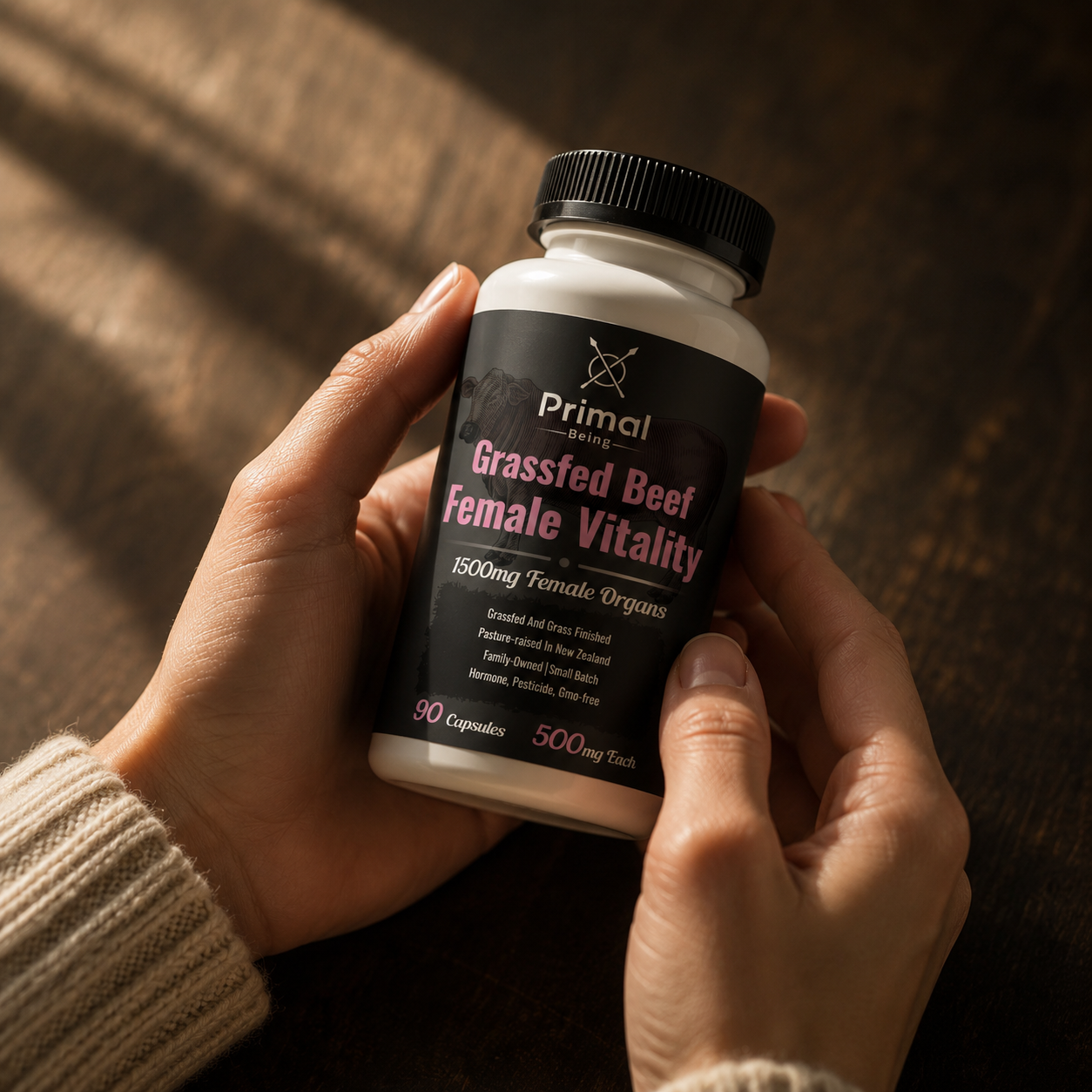
Be cautious of products with very small serving sizes that look affordable on a per-bottle basis but deliver minimal liver per serving. A bottle of 90 capsules at 500mg per capsule is not the same as a bottle of 90 capsules at 500mg per capsule taken three at a time for 1500mg per serving. Read the serving suggestion, not just the per-capsule amount.
Third Party Testing
The supplement industry is not regulated the way pharmaceuticals are. Brands are trusted to represent their products accurately. Third party testing is how a brand proves that what is on the label matches what is in the bottle.
Look for brands that publish certificates of analysis from independent laboratories, not just a badge on a website. The certificate should confirm nutrient content and the absence of contaminants including heavy metals, bacteria, and pesticide residue. Ideally it should be batch-specific, confirming that the product you are buying was tested, not just a version of it from six months ago.
Brands that do not test or do not publish results are asking for blind trust. In an unregulated market, blind trust is a significant ask.
Why Primal Being Beef Liver
Our Beef Liver meets every criterion above.
Grass-fed and grass-finished New Zealand cattle. Freeze-dried at low temperatures over an extended cycle with no heat applied to the tissue. One ingredient. No fillers, no flow agents, nothing added. Third party tested for purity and potency.
3000mg per serving in three capsules. Clean, simple, and verifiable.
If you are comparing beef liver supplements and asking which criteria actually matter, these are them. Source, processing method, ingredient list, and third party verification. Everything else on the label is marketing.