
There is a version of the past that gets oversimplified a lot.
People picture hunter-gatherers eating mostly muscle meat, living lean and hard, running down prey across open plains. The reality is more interesting and more relevant than that image suggests.
Our ancestors ate everything. When they brought down an animal, nothing was wasted. The organs came first. The liver, the heart, the kidney, the brain. These were the most prized parts of the animal. Not the steak. The parts modern people have largely stopped eating entirely.
That shift matters more than most people realize.
The Whole Animal
Before refrigeration, before grocery stores, before the idea of a boneless skinless chicken breast, people ate what the animal provided from nose to tail.
This was not a philosophy. It was practical. An animal represented a significant investment of effort to hunt or raise. Leaving any of it behind made no sense. And across cultures, in every part of the world where animals were part of the diet, the organs were considered the most valuable portion.
Liver was given to pregnant women and children. Heart and kidney went to those doing hard physical work. Brain and marrow were eaten fresh after a hunt. These were not exotic choices. They were the obvious ones for anyone who understood that the organs concentrated the most nutrition.
Modern humans kept the muscle meat and left almost everything else behind. What we lost in that trade was not just flavor or variety. It was a dense package of nutrients that supported human health for hundreds of thousands of years.
What Changed
The shift happened gradually. Industrialized food production made muscle meat cheap and convenient. Processing and packaging made organ meats harder to sell. Milder flavors won over stronger ones in a market driven by mass appeal.
By the mid twentieth century, liver and onions had moved from a weekly staple to an occasional dish. By the end of the century, organ meats had largely disappeared from Western diets altogether except in certain cultural communities that held on to traditional eating patterns.
At the same time, the supplement industry grew rapidly. Synthetic vitamins filled the shelves. The message was that modern nutrition had found a cleaner, more convenient way to get what the body needed. No taste issues. No preparation. Just take a pill.
The problem is that a synthetic vitamin and a nutrient from real food are not the same thing. The body recognizes food. It has spent a very long time learning to extract and use nutrients from whole animal sources. Isolated compounds delivered in capsule form do not arrive with the same cofactors, the same bioavailability, or the same biological context.
What the Research Actually Shows
Studies of traditional populations who maintained ancestral eating patterns consistently show lower rates of the chronic diseases that define modern health in developed countries.
Populations eating nose to tail, including organs, bone broth, and fat alongside muscle meat, were not suffering from the iron deficiency, B12 deficiency, or widespread fatigue that characterizes so much of modern life. They were getting those nutrients from food, in forms the body absorbed well, consistently.
The nutrients most commonly deficient in modern Western diets, including vitamin A, B12, heme iron, choline, and copper, are precisely the nutrients found in highest concentration in organ meats. That is not a coincidence. It is the result of removing those foods from the diet.
Coming Back to What Works
You do not need to overhaul everything you eat. The point is not to recreate a hunter-gatherer lifestyle. The point is to recognize that certain foods carried enormous nutritional value for a very long time and that removing them created real gaps.
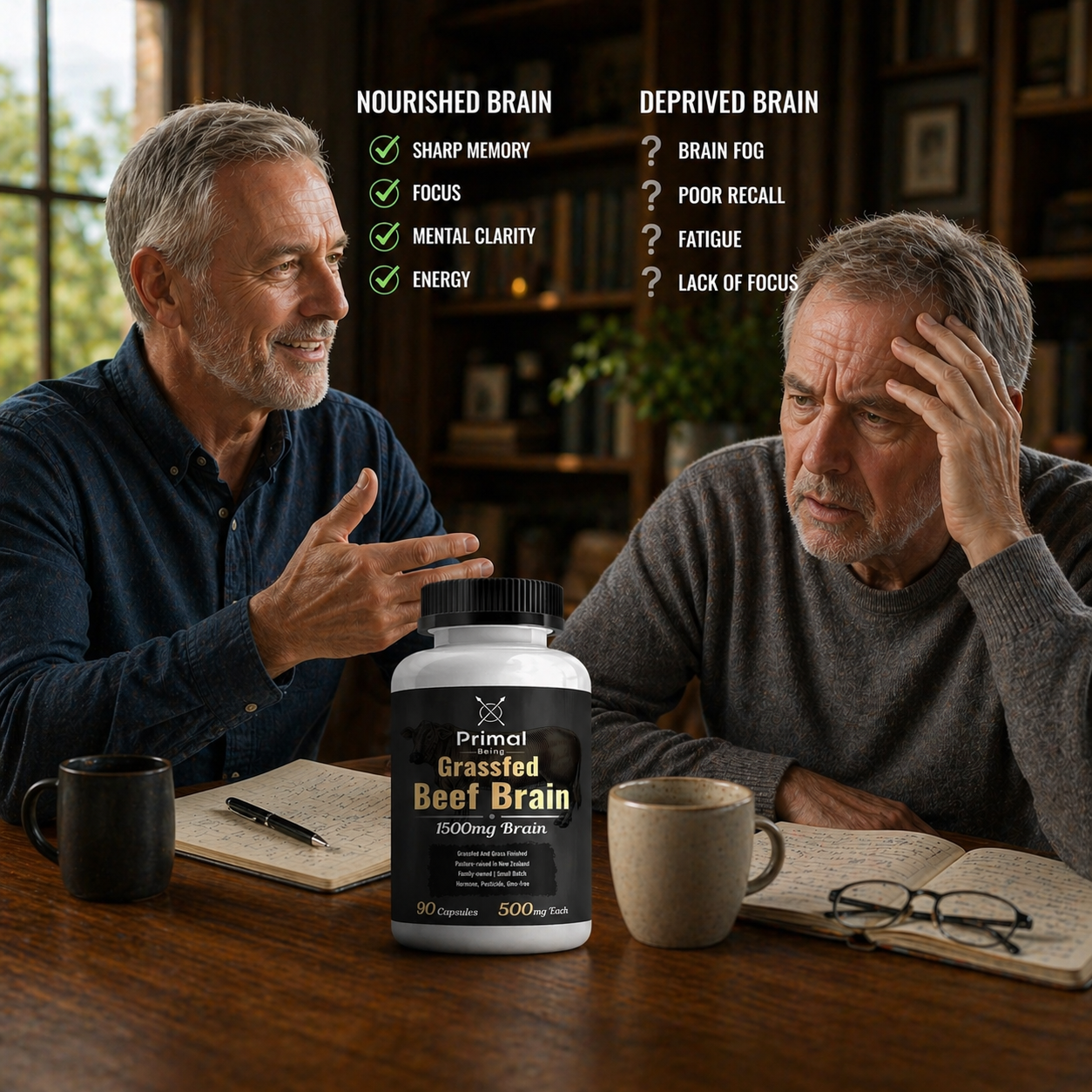
Adding organ meats back does not have to mean cooking liver every week. Freeze-dried organ supplements deliver the same nutritional profile in a form that fits a modern life. One ingredient. Real food. Nothing added.
At Primal Being that is the entire idea. Not a new system. Not a complicated protocol. Just a return to the foods that have always worked. The ones our ancestors understood long before anyone invented a label for them.